


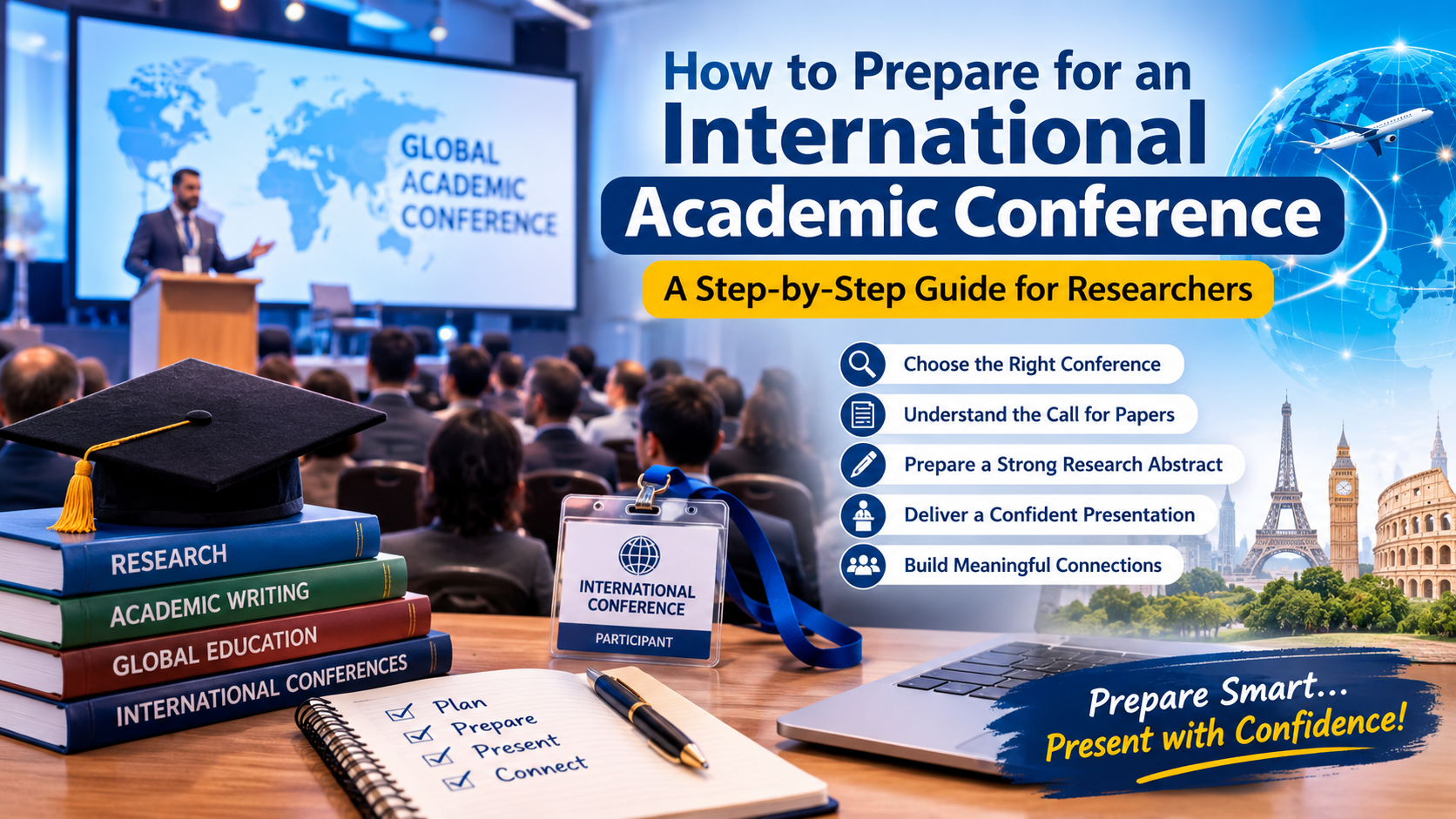
How to Prepare for an International Academic Conference: A Step-by-Step Guide for Researchers
Participating in an international academic conference is an important milestone in a researcher's academic journey. It provides an opportunity to present original research, exchange ideas with experts, receive constructive feedback, and connect with scholars from different countries and academic backgrounds.
For postgraduate students, doctoral candidates, early-career researchers, and experienced academics, international conferences can create valuable opportunities for research collaboration and professional development.
However, successful conference participation requires more than preparing a research paper and booking a flight. Researchers must carefully plan their submissions, understand conference requirements, develop effective presentations, and prepare to communicate their findings to a diverse academic audience.
This guide explains how to prepare for an international academic conference, from selecting the right event and submitting your abstract to delivering a confident presentation and building meaningful academic connections.
1. Choose the Right International Academic Conference
The first step is identifying an academic conference that aligns with your research interests, professional goals, and subject area.
International academic conferences cover a wide range of disciplines, including:
-
Social Sciences
-
Humanities
-
Business Management
-
Economics
-
Education
-
Political Science
-
Psychology
-
Interdisciplinary Studies
Before registering, consider the following factors:
Research Relevance: Ensure that the conference accepts research papers related to your specialization.
Conference Objectives: Review the conference themes, topics, and academic focus.
Organizing Association: Research the institution or academic association organizing the event.
Publication Opportunities: Check whether conference proceedings, journal publication opportunities, or special issues are available.
Participation Format: Determine whether physical, virtual, or hybrid participation is offered.
Important Deadlines: Review abstract submission, full-paper submission, registration, and presentation dates.
Always verify the conference's academic scope, submission guidelines, publication policies, and organizing body's credibility before making any payment or registration decision.
2. Understand the Call for Papers (CFP)
After selecting a suitable conference, carefully review its Call for Papers (CFP).
A Call for Papers is an official announcement inviting researchers, academics, and students to submit research abstracts or complete papers for consideration.
It generally outlines:
-
Accepted research topics and subject areas.
-
Abstract word limits and formatting requirements.
-
Full-paper submission guidelines.
-
Referencing and citation styles.
-
Language requirements.
-
Review and acceptance procedures.
-
Registration fees and payment deadlines.
Reading the CFP carefully helps researchers avoid submitting papers that do not match the conference's academic scope.
For example, researchers in social sciences and humanities may explore topics such as social inequality, economic development, cultural transformation, public policy, education, and human behaviour.
3. Prepare a Strong Research Abstract
Your abstract is often the first part of your research that conference reviewers evaluate. It should clearly communicate your research topic, objectives, methodology, findings, and contribution.
A well-written abstract generally includes five important elements:
Research Background: Introduce the topic and explain the academic problem or research gap.
Research Objectives: Clearly state what your study aims to investigate.
Methodology: Briefly describe the research methods, data sources, or theoretical framework used.
Key Findings: Present the major findings if the study has been completed. For ongoing studies, describe the expected contribution where permitted by the conference guidelines.
Research Contribution: Explain how your study contributes to existing academic knowledge or practical understanding.
Avoid unnecessary technical language, lengthy background explanations, and unsupported claims. Follow the conference's exact abstract word limit and formatting instructions.
4. Complete Your Research Paper According to Academic Standards
If the conference requires a full research paper, ensure that your manuscript follows the specified academic guidelines.
A typical research paper includes:
-
Title
-
Abstract
-
Keywords
-
Introduction
-
Literature Review
-
Methodology
-
Results and Discussion
-
Conclusion
-
References
Maintain academic integrity throughout the writing process. Use reliable references, cite original sources, and ensure that your work is original.
Researchers should also check whether the conference requires APA, MLA, Chicago, IEEE, or another referencing style.
Before submission, review your manuscript for grammar, spelling, consistent formatting, accurate citations, clear research objectives, logical arguments, and compliance with plagiarism and ethical research policies.
5. Create an Effective Conference Presentation
Once your research has been accepted, the next major task is preparing your presentation.
A conference presentation should communicate your research findings clearly, logically, and within the allotted time.
Avoid copying entire sections of your research paper into presentation slides. Instead, identify the most important points and present them in a structured format.
Recommended Presentation Structure
-
Title Slide: Research title, presenter name, institutional affiliation, and conference details.
-
Research Background: Introduce your topic and explain why it matters.
-
Research Problem and Objectives: Identify the problem and research objectives.
-
Literature Review: Highlight previous studies and the research gap.
-
Research Methodology: Explain your research design and analytical approach.
-
Findings and Results: Present major findings using concise explanations, charts, or tables.
-
Discussion: Explain the significance of your findings.
-
Conclusion and Recommendations: Summarize your research contribution.
-
Questions and Acknowledgements: Thank the audience and invite questions.
Presentation Design Tips
-
Use readable fonts and consistent formatting.
-
Avoid overcrowding slides with paragraphs.
-
Include relevant charts, diagrams, and visuals.
-
Highlight important statistics and findings.
-
Maintain a professional and simple design.
-
Use consistent colours and layouts.
Tools such as PowerPoint, Google Slides, and Canva can help researchers create professional academic presentations.
6. Practice Your Presentation and Prepare for Questions
Even well-researched presentations can become ineffective if the speaker is unprepared.
Practice your presentation several times and use a timer to ensure that you finish within the allocated duration.
For example, if you have 15 minutes to present your research, you can divide your time as follows:
-
Introduction and background: 2 minutes
-
Research objectives: 2 minutes
-
Methodology: 3 minutes
-
Findings and discussion: 5 minutes
-
Conclusion: 2 minutes
-
Buffer: 1 minute
You should also prepare for questions that conference participants may ask.
Common questions include:
-
What motivated you to select this research topic?
-
What is the main contribution of your study?
-
Why did you choose this particular methodology?
-
What limitations did you encounter?
-
How can your findings be applied in real-world situations?
-
What are the possible directions for future research?
If you do not know the answer to a question, respond honestly rather than guessing. Acknowledging limitations demonstrates academic maturity.
7. Prepare Your Travel and Conference Logistics
For researchers attending an international academic conference in another country, travel preparation is equally important.
Once your participation is confirmed, begin arranging the necessary travel and accommodation details.
Prepare the following:
-
Valid passport and required visa.
-
Conference acceptance or invitation letter.
-
Flight tickets and accommodation bookings.
-
Conference registration confirmation.
-
Travel insurance, where appropriate.
-
Copies of your research paper and presentation.
-
Emergency contact information.
-
Local transportation arrangements.
Check the conference venue's location and estimate the time required to reach it from your accommodation.
If you are presenting virtually, test your internet connection, microphone, camera, presentation software, and backup arrangements in advance.
Good logistical planning helps you avoid unnecessary stress and concentrate on your academic participation.
8. Build Meaningful Academic Connections
One of the greatest benefits of international academic conferences is the opportunity to connect with researchers from different institutions and countries.
Academic networking can lead to research collaborations, joint publications, institutional partnerships, mentorship opportunities, and future conference participation.
Here are some practical ways to build meaningful academic connections:
Introduce Yourself Confidently: Prepare a short introduction explaining your academic background, research interests, and current project.
Attend Networking Sessions: Participate in discussion sessions, workshops, panel discussions, and informal academic gatherings.
Ask Relevant Questions: Engage with other researchers by asking thoughtful questions about their studies.
Connect Digitally: Exchange professional contact information and connect through LinkedIn or institutional research networks.
Follow Up After the Conference: Send a short message thanking researchers for their discussions and expressing interest in staying connected.
Remember that meaningful academic relationships develop over time through genuine communication and shared research interests.
9. Learn From Feedback and Improve Your Research
Constructive feedback is an essential part of academic conferences.
Questions and comments from experienced researchers can help you identify weaknesses, clarify your arguments, improve your methodology, and explore new research directions.
After your presentation:
-
Record important questions and suggestions.
-
Identify areas where your research needs improvement.
-
Review recommendations from other scholars.
-
Discuss useful feedback with your research supervisor or co-authors.
-
Incorporate relevant suggestions into future research.
Instead of treating criticism negatively, consider it an opportunity to strengthen your academic work.
10. Follow Up and Make the Most of Your Conference Experience
Your academic conference experience should not end when the event concludes.
The days following a conference provide an excellent opportunity to organize your learning, strengthen professional relationships, and develop your research further.
Consider these activities:
-
Review your presentation notes and audience feedback.
-
Contact researchers you met during the event.
-
Explore opportunities for joint research projects.
-
Revise your paper based on relevant suggestions.
-
Investigate suitable journals for publication.
-
Share your conference experience with your academic community.
-
Stay informed about upcoming international academic conferences.
If the conference provides proceedings or publication opportunities, carefully review the applicable editorial and peer-review requirements.
Not every conference presentation automatically results in a journal publication. Researchers should evaluate journal quality, publication policies, and submission requirements before submitting their work.
Common Mistakes to Avoid When Attending an International Academic Conference
Even experienced researchers can make mistakes that reduce the value of their conference participation.
Some common mistakes include:
-
Submitting an unrelated abstract: Ensure your research matches the conference theme.
-
Ignoring submission guidelines: Follow word limits, formatting rules, and deadlines carefully.
-
Overloading presentation slides: Focus on essential findings instead of excessive text.
-
Failing to rehearse: Practice your presentation to improve timing and confidence.
-
Avoiding networking opportunities: Engage with fellow researchers and speakers.
-
Ignoring audience feedback: Use constructive comments to improve your research.
-
Not following up: Maintain professional connections after the event.
Avoiding these mistakes can help you participate more confidently and gain greater academic value from international conferences.
Conclusion
Preparing for an international academic conference requires careful planning, effective communication, and a genuine interest in academic exchange.
From selecting the right conference and writing a compelling abstract to delivering a professional presentation and building international research connections, every stage contributes to a successful experience.
For early-career researchers and experienced academics alike, international conferences provide valuable opportunities to share knowledge, receive constructive feedback, discover new research perspectives, and develop professional relationships.
Through its academic activities and research-oriented platform, the Social Science and Humanities Research Association (SSHRA) encourages scholars to engage with international research communities and explore opportunities for academic exchange.
Start preparing early, present your research confidently, and make every academic interaction count.
Frequently Asked Questions (FAQs)
1. How do I prepare for my first international academic conference?
Start by selecting a relevant conference, reviewing its Call for Papers, preparing your abstract and research paper, and creating a structured presentation. Practice speaking, research the event's requirements, and arrange travel or virtual participation details in advance.
2. What should I include in an academic conference presentation?
An academic presentation should generally include your research background, problem statement, objectives, literature review, methodology, findings, discussion, and conclusion. Keep slides concise and focus on your most important research contributions.
3. How long should an international conference presentation be?
Presentation duration depends on the conference schedule. Many academic presentations last between 10 and 20 minutes, followed by a question-and-answer session. Always check the official presentation guidelines.
4. How can I get my research paper accepted at an international conference?
Choose a conference that matches your research area, carefully follow its submission guidelines, write a clear abstract, demonstrate the relevance of your research, and submit an original, well-structured paper before the deadline.
5. What are the benefits of attending international academic conferences?
International conferences help researchers present their work, receive expert feedback, develop academic networks, explore research collaborations, discover new perspectives, and learn about developments in their respective fields.
6. Can students attend international academic conferences?
Yes. Undergraduate students, postgraduate students, doctoral candidates, and early-career researchers can participate in many international academic conferences, depending on the event's eligibility and submission requirements.
7. How can I network effectively at an academic conference?
Introduce yourself to fellow researchers, participate in discussions, attend networking sessions, ask meaningful questions, exchange professional contact details, and follow up with new connections after the event.
